

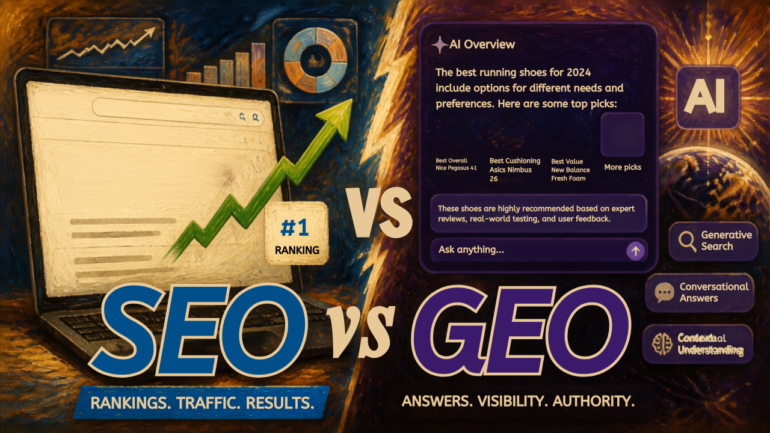
GEO VS SEO — THE SHORT VERSION
GEO vs SEO comes down to a simple distinction: SEO optimizes content to rank in a list of search results; GEO optimizes content to be cited inside an AI-generated answer. They share the same foundation — technical health, credible content, real backlinks — but measure success differently and require different tactics on top. Gartner projects organic search traffic could fall 50% or more by 2028 as generative AI search scales, which is why GEO vs SEO is no longer a hypothetical debate for most businesses.
50%
5x
65%+
2
GEO vs SEO: What Actually Differs
Most people searching seo vs geo want a straight answer, so here it is before the detail.
In short: SEO gets a page ranked on a results page a person has to click through. GEO gets a brand mentioned inside the answer an AI system gives directly — no click required. Both matter, but they’re won with different signals and measured with different numbers.
Definition
GEO (Generative Engine Optimization)
GEO is the practice of structuring content so it gets cited, quoted, or summarized by generative AI systems like ChatGPT, Gemini, and Perplexity when they answer a user’s question. Where SEO optimizes for a ranking position, GEO optimizes for inclusion inside a synthesized answer — success looks like a citation or a brand mention, not a blue link and a click.
The GEO vs SEO comparison exists because AI-generated answers are becoming a real, measurable share of how people find information. Gartner projects that organic search traffic could decline by 50% or more by 2028 as consumers shift toward generative AI-powered search (see Gartner’s research), and SparkToro/Datos data already shows more than 65% of Google searches ending without a click. Neither trend means SEO is dying — but it does mean GEO is no longer optional to understand.
Worth Knowing
GEO and SEO aren’t rival disciplines competing for the same budget line — they largely reward the same underlying signals: technical site health, clear factual content, and real third-party credibility. The tactics on top diverge; the foundation doesn’t.
How SEO and GEO Actually Work
Understanding the mechanics behind each system explains why the GEO vs SEO comparison isn’t a like-for-like swap.
Why GEO vs SEO Matters Right Now
The comparison has gone from academic to practical fast, driven by real shifts in search behavior.
Organic Traffic Is Under Real Pressure
Gartner’s own projection — a 50%+ decline in organic search traffic by 2028 — is a direct warning that SEO-only strategies are exposed to a shrinking channel over the medium term.
Zero-Click Search Is Already the Norm
With more than 65% of Google searches ending without a click, a page that ranks perfectly well may still generate far less traffic than it would have five years ago.
AI Citation Is Growing Fast
Press release citations across ChatGPT, Gemini, and Perplexity grew fivefold between July and December 2025, according to Muck Rack’s Generative Pulse research — a sign of how quickly the GEO side of the equation is scaling.
High-Consideration Buyers Are Moving First
Complex, high-value purchase decisions — enterprise software, professional services, big-ticket B2B — are where buyers are most likely to ask an AI tool to compare options before ever visiting a website.
Building a Strategy That Covers Both
- Fix the technical foundation firstSite speed, crawlability, and clean structured data support both SEO rankings and GEO retrieval — this step benefits both channels equally and should never be skipped.
- Write for extractable facts, not just keywordsSpecific statistics, named sources, and clear definitions get pulled into AI answers far more often than vague, promotional language — while still supporting traditional on-page SEO.
- Earn real third-party citationsBacklinks and press coverage on credible outlets remain one of the strongest shared signals across both SEO authority and GEO citation eligibility. See our guide on how to get mentioned in ChatGPT for the specific mechanics.
- Structure content for both humans and modelsClear headings, FAQ sections, and defined terms help search engines parse a page and help AI models extract clean, quotable answers from it.
- Track both sets of metrics separatelyKeep measuring organic rankings and traffic for SEO, and start tracking brand mentions and citation frequency across AI tools for GEO — they’re genuinely different scoreboards. Our guide on measuring PR and content ROI covers how to approach this in practice.
“The GEO vs SEO debate misses the point when it’s framed as a choice — the businesses winning right now are the ones treating it as one authority-building effort with two different scoreboards.”
— Mi Gazette Editorial, 2026
GEO vs SEO: Head-to-Head
Does GEO Replace SEO?
No — and treating the seo vs geo question as an either/or choice is the most common mistake businesses make right now. Traditional search still sends far more total traffic than AI answer engines today. Read our broader guide on why GEO is the future of search without SEO becoming obsolete for the fuller argument. What’s changing is the shape of the opportunity: SEO still owns the largest slice of the discovery pie, while GEO is the fastest-growing slice — and both draw on the same underlying credibility signals to succeed.
How to Think About It
Treat SEO as the channel that still earns the most total volume today, and GEO as the channel compounding the fastest. A business that only optimizes for one is deliberately ignoring either its largest or its fastest-growing source of future visibility.
Every business asking “GEO or SEO” is asking the wrong question. The real question is which one is under-invested relative to where your buyers actually are — and for most companies right now, that’s GEO.
— Mi Gazette Editorial, 2026
Key Takeaways — What to Remember
GEO vs SEO — Summary
- SEO optimizes for ranking position; GEO optimizes for citation inside an AI-generated answer
- Gartner projects organic search traffic could fall 50%+ by 2028 as generative AI search scales
- More than 65% of Google searches already end without a click (SparkToro/Datos)
- Press release citations across ChatGPT, Gemini, and Perplexity grew 5x between July and December 2025 (Muck Rack)
- SEO and GEO share the same foundation: technical health, credible content, and real backlinks
- GEO content favors concise, fact-dense, quotable passages over broad keyword coverage
- GEO does not replace SEO — traditional search still sends far more total traffic today
- High-consideration B2B buyers are the audience most likely to research through AI tools first
The Bottom Line
The GEO vs SEO comparison isn’t a competition with one winner — it’s two measurement systems built on the same foundation of technical health, credible content, and real third-party authority. SEO still drives the majority of total traffic today, but Gartner’s own projections and the fast growth in AI citation volume mean GEO is no longer a channel businesses can ignore. The strategy that wins in 2026 treats them as one authority-building effort, tracked on two different scoreboards.
Frequently Asked Questions
Build a Strategy That Covers Both GEO and SEO
Mi Gazette combines press release distribution with GEO-aligned content — placements on outlets like Business Insider, Reuters, Yahoo Finance, and AP News build the exact third-party credibility both SEO and GEO reward. See our full SEO, GEO, and Digital PR packages.